Another Attack on Niger International Airport Last Week
On By Dr. Y.
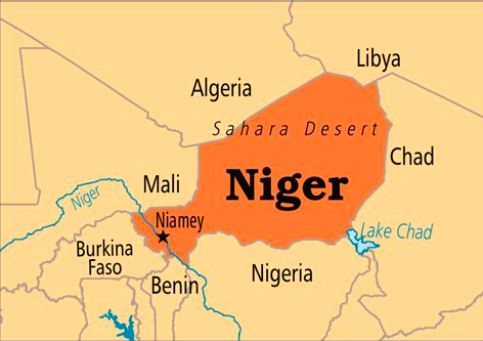
Map of Niger
Last Thursday, there was another attack on Niger’s main airport, the Diori Hamani International Airport in Niamey. In the early hours of the morning, inhabitants of the capital Niamey heard gunshots. This new wave of attacks by gunmen is said to have killed 11soldiers and 2 civilians on the government side, while government forces repelled the attack and killed 22 assailants. According to the government statement read out on state television, 20 people were arrested and assorted weapons seized. A large cache of weapons including RPG-7 launchers, AK-47 rifles, explosives, grenades, communications equipment and thousands of rounds of ammunition were also reportedly seized. The assailants also mixed in with the local population to run from the government, but were caught by local residents who joined forces with soldiers to unearth them. And of course, foreign media were rejoicing and could not wait to tell us all about it. Let’s keep our countries in our heart all the time and remain strong! The enemy lurks, but we stay alert!We will never give up!
Gunmen launched a violent assault on the Diori Hamani International Airport, which serves the capital city of Niamey, Niger, in the early hours of Thursday, June 18, 2026. The attack shattered the morning calm with sustained gunfire and multiple explosions, prompting an urgent mobilization of national security forces. The incident began at approximately 6:00 a.m. local time (05:00 GMT), leading to a security standoff that lasted for nearly an hour, with intense fighting concentrated near the airport’s main gate. One local resident described the scene, noting, “I heard the first gunshots at 06:00 (05:00 local time) while I was at the mosque. But the current situation is under control.”
Government security forces acted with speed to repel the assailants after the facility’s perimeter was breached. By mid-morning, soldiers were conducting rigorous security checks on travelers and civilians along the roads surrounding the airport. While government authorities have yet to issue a formal statement, security sources confirmed that the army successfully neutralized the immediate threat and pushed back the gunmen. Reports indicate the fleeing attackers abandoned several weapons at the scene. These ongoing security challenges persist despite recent government measures to bolster defenses, which included the demolition of adjacent neighborhoods identified as “terrorist risks” and the installation of over 350 surveillance cameras to monitor the facility.
PD Lawton with Jerm Warfare : I discuss the role of insurgencies/ low-intensity wars on the African continent and how the media use perception modification to keep eyes off reality.
Source: UK Column News and UK Column
There is No Christian Genocide in Nigeria | Jerm Warfare
25 June 2026
P.D. Lawton argues that conflicts like Boko Haram are synthetic, Western-backed insurgencies designed to keep African states weak while corporations extract minerals cheaply — She cites the PMC Executive Outcomes, which routed Boko Haram in four weeks before it was dismissed so the insurgency could continue. She links this to a Kissinger-era destabilisation doctrine, flags the UK–Rwanda deal as to have funded Kagame’s Congo operations, and sees hope in the Alliance of Sahelian States (Burkina Faso, Mali, Niger), where military governments reclaim their mineral wealth and infrastructure, to include a neglected continental railway project.
The military, on their own, are completely overstretched. You can count almost over 30 terrorist operations in this country where military personnel are deployed,
Jackson-Ojo also lamented the loss of senior military officers in recent months. “Within the past three months, we have lost almost four generals and there is no reprisal attack,” he said.
He criticised the reintegration of repentant terrorists into society, arguing that the approach sends the wrong message. “I’ve never heard it anywhere in the world that terrorists who have terrorised, damaged and killed will be integrated back into society. To me, I think the government is totally helpless. Something, or many things, are wrong now,” he added.
Billions Spent on Security, Yet Nigeria Records 98 Violent Attacks in Just One Week
By Blessing Uma
The Federal Government spent N57.78 billion on security-related projects and operations between January and April 2026, even as Nigeria continued to battle widespread insecurity, with 98 criminal incidents recorded nationwide within a single week.
Data obtained from the Open Treasury Portal showed that the amount represented a 127.97 per cent increase from the N25.35 billion spent during the same period in 2025. The expenditure covered defence equipment procurement, security infrastructure, military barracks, police facilities, and other security-related projects.
Despite the increase in spending, attacks by terrorists, bandits, kidnappers and other armed groups have continued unabated in several parts of the country, prompting fresh concerns over the effectiveness of government efforts to address the security crisis.
Analysis of the Treasury Portal data revealed that the N57.78 billion spent as of April accounted for only 1.24 per cent of the N4.66 trillion allocated to security in the 2026 budget, indicating a low level of implementation within the first four months of the year.
The largest share of the expenditure, N21.39 billion, was committed to the procurement of defence equipment, representing about 37 per cent of the total security spending during the period. Another N14.16 billion was spent on security equipment, while N5.84 billion went into the construction and provision of military barracks. The government also disbursed N5.17 billion for police stations and barracks, N3.26 billion for the rehabilitation of defence equipment, N2.39 billion for defence facilities, and N2.16 billion for repairs of military barracks.
In addition, N3 billion was spent on security services, while N320.94 million was released as security votes. However, several key programmes recorded no expenditure. No funds had been released under the military operations budget line tagged “Operation Lafiya Dole and Other Operations of the Armed Forces,” despite a N500 million provision in the 2026 budget. Likewise, no money had been spent on the kitting of Armed Forces personnel, even though N2.53 billion had been earmarked for the initiative.
Compared with the same period in 2025, spending on defence equipment more than doubled, rising from N9.48 billion to N21.39 billion, while expenditure on military barracks construction increased from zero to N5.84 billion. Nevertheless, implementation rates across many security projects remained below three per cent.
The spending figures emerged as a police security report obtained by The PUNCH revealed that 98 criminal incidents were recorded across Nigeria within the last seven days. The report documented 37 homicide cases, 27 banditry attacks, 24 kidnappings, eight armed robbery incidents, and two terrorism-related attacks.
The incidents were reported in Kaduna, Katsina, Zamfara, Kebbi and several other states, involving mass abductions, attacks on rural communities, and kidnappings along major highways.
Among the most disturbing cases was the abduction of 39 residents in Zamfara State after they reportedly travelled into the Fadama Forest to negotiate peace with a notorious bandit leader, Jimo Smally.
In Katsina State, bandits blocked the Katsina-Kankara Highway and intercepted a commercial vehicle carrying 11 passengers. Security operatives later rescued nine of the victims, while the driver and another passenger remained missing.
Reacting to the situation, security analyst Lekan Jackson-Ojo described the crisis as the worst insecurity challenge in Nigeria’s history. “This is the highest level of insecurity in the military and political history of the Federal Republic of Nigeria,” he said.
According to him, the prevailing insecurity has serious economic consequences. “It is an indirect pronouncement that Nigeria is an unsafe territory now. We are having a battered economy, and there is no economy anywhere in the world that thrives under insecurity,” he stated.
Jackson-Ojo also lamented the loss of senior military officers in recent months. “Within the past three months, we have lost almost four generals and there is no reprisal attack,” he said.
He criticised the reintegration of repentant terrorists into society, arguing that the approach sends the wrong message. “I’ve never heard it anywhere in the world that terrorists who have terrorised, damaged and killed will be integrated back into society. To me, I think the government is totally helpless. Something, or many things, are wrong now,” he added.
The security expert further accused the political class of focusing more on electioneering activities than addressing the nation’s security concerns. “What preoccupies our political class is campaign, campaign, campaign and campaign. This is a sad situation,” he stressed.
Another security analyst, Chidi Omeje, argued that Nigeria’s armed forces remain overstretched despite the increased spending. “The military, on their own, are completely overstretched. You can count almost over 30 terrorist operations in this country where military personnel are deployed,” he said.
Omeje maintained that military operations alone would not resolve the country’s security challenges. “Unless we are able to deal with the root causes, we will keep going in circles. Most of the issues are born out of bad governance, wrong prioritisation, corruption and pervasive poverty, which has made people see crime and criminality as an option for survival,” he noted.
He also blamed porous borders and instability across the Sahel region for worsening insecurity in Nigeria. “From Mali to Burkina Faso to Nigeria those places are the epicentre of terrorism. Nigeria is an attractive destination because we have porous borders and poor border management,” he stated.
Calling for urgent action, Omeje said the government must demonstrate stronger leadership in tackling the crisis. “The government seems almost clueless about how to go about this matter. They are paid to find solutions — so they must find solutions,” he added.
The latest figures underscore the disconnect between increased security spending and the reality on the ground, where violent attacks continue to claim lives and disrupt communities. They also highlight the urgent need for more effective implementation of security budgets and a comprehensive strategy that addresses both the immediate threats and the underlying drivers of insecurity across the country.
On her final day as Director of National Intelligence, Tulsi Gabbard released never-before-seen communications and documents exposing Anthony Fauci’s central role in the early COVID-19 origins debate. The materials show that Fauci directed U.S. taxpayer funding toward gain-of-function research at the Wuhan Institute of Virology while simultaneously advising intelligence agencies and publicly labelling the lab-leak hypothesis a conspiracy theory.
The declassified files detail a closed information loop in which Fauci supplied NIAID-funded scientists to shape intelligence assessments, creating what critics describe as a self-reinforcing narrative favouring natural origins. They also reference retaliation against intelligence analysts who advocated examining the lab-leak possibility, with Gabbard referring those accounts to the Inspector General.
Who buys Rwanda’s smuggled coltan? The global journey of conflict coltan from DRC to the world’s electronics
Published:
M23 soldiers at the mining pits in Rubaya. Camille Laffont / AFP / Getty ImagesConflict coltan smuggled from the war-torn Democratic Republic of the Congo (DRC) is finding its way into global markets and popular consumer products, despite due diligence systems
Where have over 2,000 tonnes of smuggled conflict coltan gone?
These looted minerals come from mines in Rubaya in the Democratic Republic of the Congo (DRC), which produce 15% of the world’s tantalum, a key ingredient for electronic products found in smartphones, laptops and cars around the world.
The Rubaya mines have become a main revenue source for M23’s brutal warfare in DRC. Seizing vast areas of territory, the armed group backed by Rwanda’s military has killed thousands and displaced hundreds of thousands of civilians, abducting and torturing with impunity.
But once the coltan is smuggled to Rwanda, little is known about who buys it or where it goes.
In a year-long investigation, Global Witness followed the DRC’s conflict coltan from the mines across the border and into global supply chains. We established the complicity of Rwandan officials, as smuggling reached “unprecedented” levels.
With Rwanda’s coltan exports more than doubling over the past three years, we identified the seven companies that exported 85% of the coltan.
Through interviews with coltan smugglers, we found that at least five of these seven companies buy conflict coltan from DRC, selling it on through middlemen to smelters in China and Kazakhstan.
WILL NIGERIA GO INTO A POLITICAL TURMOIL OVER MISMANAGEMENT OF ELECTIONS BY THE ELECTORAL UMPIRE, INEC, AND THE COURTS?
by Frank Talk 10 June 2026
On January 16, 2027, Nigeria, Africa’s largest democracy, goes to a general election once again – it will be the 14th time since the most populous African country has held elections after decades of military rule. But there are fears that the process will not go on smoothly. There have been strong indications that the government in power has been using underhanded means to manipulate the processes leading to the elections, which may render them uncredible and throw the country into a state of chaos.
There are questions as to whether the nation’s electoral umpire, the so styled Independent Electoral Commission, INEC, is truly independent.
Image: Prof. Joas Amupitan, chairman of Nigeria’s Independent Electoral Commission, INEC, at the centre of the storm if he will allow opposition parties to have a level playing field in the country’s upcoming general elections in 2027.
On October 23 last year, Nigeria’s President, Bola Ahmed Tinubu, appointed and swore-in a new INEC Chairman, Joash Amupitan, a Professor of Law at one of the country’s foremost universities, the University of Jos. Previously unknown in the country’s national landscape, his appointment immediately elicited controversy that led Muslims to call for his removal. Nigeria is almost equally divided between Christians and Muslims but has mostly been ruled by Muslims. He had previously written a legal brief in 2020 in which he described the killings in parts of Northern Nigeria as “crimes against humanity, war crimes and genocide” against Christians. Northern Nigeria’s Muslim-dominated leaders fear that he may be biased against them on account of his religious views and called for his immediate removal.
While that controversy was yet to die down, it was revealed last month that he had rooted for the victory of Tinubu in the country’s last general elections in 2023. Nigeria’s social media-savvy generation dug up a comment he made on someone’s X post in which he simply said, “victory is sure.” The post soon went viral and became a topic of discussion in beer parlours. He tried to wriggle himself out of the controversy by denying that the account linked to him belonged to him, claiming it was a pseudo account, but this did not work, as Grok, the Elon Musk-founded AI platform, verified the account as rightfully owned by him. To compound the matter, his phone number and personal email address were linked to the account.
The most talked-about aspect of his leadership is his inability, or perhaps unwillingness, to manage Nigeria’s political parties. In Nigeria, it is the duty of INEC to regulate the activities of political parties as well as conduct elections.
Nigeria has two dominant political parties, the All Progressives Congress, APC, and the Peoples Democratic Party (PDP). However, the country has recently witnessed the emergence of two other parties with growing memberships – the African Democratic Congress, ADC, and the Nigeria Democratic Congress, NDC. These are in addition to another 18 smaller parties, all competing in the political space.
So far, only the ruling APC appears to enjoy clear recognition from INEC. Other major parties are being pushed out of the electoral calendar by being excluded from the list of parties approved to contest the elections. This is allegedly being engineered through Nigeria’s compromised court system. Majority of Nigerians believe the government is backing individuals to file weak lawsuits aimed at destabilising these parties. INEC has, in turn, appeared to side with those groups by listing APC-aligned members on its website as the legitimate “faction” of rival parties rather than rejecting them. Instead of helping those parties organise and compete fairly, the commission has done little to support their participation in the upcoming elections. It is alleged that the ultimate aim is to ensure that the president is the only viable candidate in the election, thereby presenting Nigerians with a fait accompli.
Image: Minister Nyesom Wike, President Tinubu’s man-friday, and powerful minister of the federal capital territory. Considered to be the distruptor of Nigeria’s electoral system for a free and fair elections in 2027
The PDP, for instance, has been torn apart by “factions” allegedly fuelled by Nyesom Wike, the powerful Minister of the Federal Capital Territory and one of President Tinubu’s right-hand men. He has sworn not to allow the party to field a formidable presidential candidate in the upcoming elections.
For over a year now, the PDP has been enamoured in courtroom battles stirred by Wike and his followers. At every turn, INEC has thrown its weight behind his group, to the dismay of majority of Nigerians.
But now, the upper courts appear to be doing justice. Recent rulings have poured chilly water on claims of legitimacy by the so-called Wike “faction” of the party. The Supreme Court of Nigeria was the first to pull the rug from under their feet when it held that the faction cannot legally make representations on behalf of the party in court because its members had been expelled from the party.
But INEC still drags its feet in implementing the decision of the highest court of the land and has continued to retain the names of the leadership of the unlawful “faction” on its website.
Image: Judge Uche Agomah: Rough judge who awarded litigant reliefs which they did not sought for in their applications before her. Described by the Court of Appeal as acting ultra petita and her judgement berated at superstructure which the substructure has been removed
INEC claims to have derived its authority from the decision of a rogue judge, Justice Uche Agomoh of the Federal High Court, Ibadan Division, who ruled and granted reliefs that none of the litigants in the case sought. In legal parlance, she acted ultra petita.
It turned out that Justice Agomoh was for 28years, a lawyer and Head of Chambers to Chief J.B. Daudu, SAN, counsel to Minister Wike’s “faction” of the PDP. It was from J.B Daudu’s employ that she was appointed a judge. Critics argue that her interest was conflicted and that she ought to have removed herself from all PDP-related cases in which her former law firm had an interest.
Image: Justice Uchechukwu Onyemenam, Justice of the Court of Appeal who berated the judge of the lower court by calling her ruling, ultra peitat – legal maxim meaning granting what the litigants did not ask for.
Last week, a panel of three Justices of the Court of Appeal criticised Justice Agomoh in a concurring judgement, referring to her ruling as “ultra petita”, a Latin maxim for a judge who grants reliefs not sought by litigants. The Justices voided her ruling, declaring it a nullity ab initio in view of the subsisting Supreme Court judgement of March 30. The Justices likened her ruling to a superstructure whose substructure had been removed, and which therefore could not stand.
The Court of Appeal held that the earlier Supreme Court judgement is final and that no lower court can reopen issues already settled.
For now, the nation awaits what INEC will do; whether the commission will give due regard to the legitimate claimants to the leadership of the party led by Kabiru Turaki, a Senior Advocate of Nigeria, SAN, or otherwise. Incidentally, the Turaki-led PDP presents former President Goodluck Jonathan, the erstwhile Nigerian President who has achieved a global image as an exceptional democrat, as its presidential candidate in the upcoming general elections; an offer which Minister Wike wants Dr. Goodluck Jonathan to reject.
Nigeria remains a fragile state. With a population of over 250 million, it is Africa’s most populous country. Over the past decade, it has faced violent Islamist insurgencies, including Boko Haram, ISWAP, and ISIS-linked groups, while kidnapping has become increasingly widespread. Combined with economic hardship, even a minor trigger could ignite unrest that spreads quickly across Africa and beyond. INEC’s actions—or failure to act—could become that trigger for a growing and dissatisfied population.
Rupert Lowe’s DEVASTATING Warning That Every British Family Needs To Hear Right Now
7 June 2026
Rupert Lowe’s DEVASTATING Warning That Every British Family Needs To Hear Right Now Something is happening inside Westminster that the government does not want you to know. Rupert Lowe — MP and founder of Restore Britain — has sat in those rooms, heard those private conversations, and watched ministers say one thing in Parliament and the opposite in the corridor. In this video, he delivers the warning every British family deserves to hear: on migration, energy security, NHS collapse, and a political class that has chosen managed deception over honest governance. This is not commentary. This is a firsthand account from inside the system.
8 days. That is all it took. On the 26th of May, JNIM hit 2 Beninese army posts on the Burkina Faso border and killed 4 soldiers — 2 days after Romuald Wadagni was sworn in as president of Benin Republic. The message was simple: stay away from the Sahel. By the 2nd of June, Wadagni was in Niamey being received by Niger’s leader with full military honours, and in Ouagadougou the same afternoon shaking hands with Captain Ibrahim Traoré. In this episode we connect the attack to the tour and show why it backfired — uniting Benin with the Alliance of Sahel States instead of scaring it off. We cover the verified facts: the first foreign trips to Nigeria, Niger and Burkina Faso, the joint communiqués, the 15-day expert committee on reopening the Benin–Niger border, and the Port of Cotonou as the lifeline for landlocked Niger and Burkina Faso. Then we ask the harder question — how far can this go while France is still Benin’s security partner, and whether Wadagni stays the course or drifts back the way others have. We centre Africa in global affairs with analysis, not emotion. No propaganda. No unverified casualty numbers. Just the facts and what they mean.