Monthly Archives: April 2023

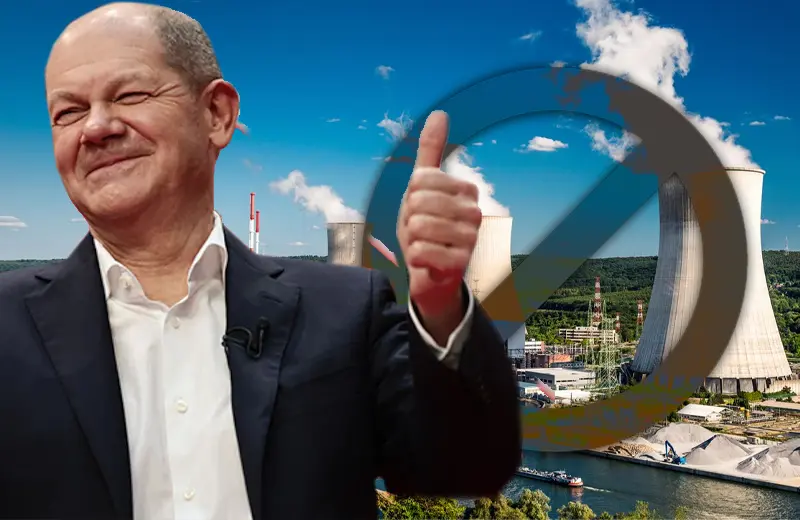
Germany Celebrates Fealty to Depopulation Lobby with Shut Down of Nuclear Energy Sector

re posted from                          THE LAST AMERICAN VAGABOND

Germany Celebrates Fealty to Depopulation Lobby with Shut Down of Nuclear Energy Sector
 

by Matthew Ehret               28 April 2023

This week, Germany signaled its willingness to serve as some techno feudal sacrifice appeasing Gaia’s demands for blood by shutting down the last three nuclear reactors. Amidst the greatest (self-induced) energy crisis caused by demands to cut Europe off of cheap Russian gas, Germany’s Minister for the Environment Steffi Lemke stated with all the confidence of a devoted cult member “The position of the German government is clear: nuclear power is not green. Nor is it sustainable… We are embarking on a new era of energy production.”

As we will soon come to see, this “new era of energy production” is in truth, merely a euphemism for depopulation which would be easier to see if the political class had not been intellectually castrated in the basics of energy, science, or morality.

Germany is not alone in this race to the bottom but joined by a handful of other European nations which have been told that the disaster that tore apart the lives of millions of people in Fukushima in March 2011 was so dangerous that all nuclear energy had to be dismantled post haste. In Ireland, laws were passed in 1999 making it illegal to ever construct nuclear power, and in Switzerland, a 2017 referendum demanded that all reactors be shut down. In 2021 Belgium had voted to completely shut down its nuclear sector by 2025 while Spain committed to shut down its entire nuclear sector in 2019 which currently supplies the nation with 20% of its energy. Earlier Denmark passed a resolution in 1985 to never build a nuclear reactor, and Italy shut down its last reactors in 1990. Between 2011-2020, 48 GW of nuclear energy was lost (primarily in western nations trapped within the zero-growth cage of NATO).

The fact is that 12 years after the Tsunami struck the west Coast of Japan killing 18,000 civilians, not one Fukushima death is traceable to radiation exposure. While a meltdown did strike three of the ten reactors in the Daiichi complex, those which suffered damages used outdated technology and cut corners in safety standards such that no coolants were available once electricity was lost after the 8.9 earthquake struck. Those deaths which did occur in the aftermath, had more to do with heart attacks caused by the vast fear-driven evacuation of 160,000 citizens from towns across the coast of Japan — many of which remain abandoned to this day as 100,000 are still considered “nuclear refugees”. After extensive testing, the WHO found radiation levels of evacuees to be undetectable… a fact which has done little to reverse the deeply embedded fears within the Japanese zeitgeist, whose robust layout of 54 nuclear plants providing high quality, reliable and affordable energy to Japanese industry and citizens in 2011 has fallen to a mere 10 operational plants today (with only 5 actually supplying energy at any given time).

continue reading HERE: Source:

Germany Celebrates Fealty to Depopulation Lobby with Shut Down of Nuclear Energy Sector


Australia: RBA Review: Killing democracy! / Payday for pigs gorging at war trough

Australian ( and Western) banking mafia clawing increased powers

Source: Australian Citizens Party

29 April 2023

1. RBA Review dictates end of democracy and sovereignty 2. Payday for pigs gorging at the war trough

Presented by Elisa Barwick and Robert Barwick

Unrest in Sudan

re posted from                                 AFRO LEGENDS

Unrest in Sudan

Flag of Sudan

A few weeks ago, we talked about The New Scramble for Africa. Our hearts go out to our brothers and sisters in Sudan as unrest rises in the country. Those who think that this is a “simple” feud between two generals, or two “brothers” as portrayed in the news, must look deeper. Why are US troops getting deployed there? In the early 2000s, people around the globe were bombarded non-stop with information about the genocide in Darfur and “slavery” in Sudan; we were all told that Northern Sudanese were “white” who treated poorly their Southern Sudanese brothers who were “Black” which is a very simplistic and exaggerated way of looking at Sudan (remember Libya and Slavery: Sheep without a Shepherd in recent years?). Hollywood stars such as George Clooney came out in numbers claiming to care about the plight of the Black man, and saying that the Black people of Darfur Sudan were enslaved by their lighter skinned Sudanese brothers.To all who know the tactic of divide-and-conquer, and know social conflicts in Africa, we are always manipulated into thinking that every conflict in Africa is about this tribe vs. that tribe, this group vs. group; thus neighbors become enemies, when in reality, it is a diamond mine or oil field coveted by external forces which is at the core of the issue (Northern Mozambique today). The conflict in Sudan led to the split of Sudan, which was then Africa’s largest country, into Sudan with capital in Khartoum, and South Sudan with capital in Juba. Many forget that the southern part of then-Sudan was rich in oil fields, and that this split diminished Sudan’s oil output to the detriment of the newly created South Sudan (in passing, wasn’t the Pope in South Sudan in February? The Pope Visits the Democratic Republic of Congo and South Sudan), thus putting a big dint on Sudan’s partnerships with China (Sudan was providing more than 10% of China’s oil needs and a Chinese presence on the horn of Africa). After the split, the world’s attention which was on Darfur moved on, Darfur which was supposedly the goal of Western interventions was never resolved, but South Sudan with the oil fields was detached from Sudan.

The New Scramble for Africa (Source: Source: Dr Jack & Curtis for City Press, National Institute African Studies (NIAS))

The cold war between the West and the East took place mostly in other countries like Angola, Mozambique, Congo, Afghanistan, Nicaragua in Africa, Asia, Latin America with many coups d’état and conflicts around the globe. Similarly today, the new kind of war has started yet again, but this time, it is on African soil with The New Scramble for Africa as the world moves toward energy-“conscious” policies.

How do we, Africans, stop from having our lands be a theater for others’ wars? How can we independently make learned decisions for our people without being dragged in others’ conflict?

Source:

https://afrolegends.com/2023/04/28/unrest-in-sudan/

Sudan, Yemen, Soldiers for Hire, UAE and Saudi Gold Networks: how they are connected

this is an extraordinarily enlightening interview conducted by Hugo Kruger with journalist Isa Blumi who explains the destabilization of Sudan and how it is connected to war in Yemen

Source: Hugo Kruger

The end to the War in Yemen?

27 April

In conversation with Isa Blumi on the latest developments regarding the War in Yemen.

Sudan: Regime-Change Violence, Begun April 15, Is Still Not Defeated

Sudan: Regime-Change Violence, Begun April 15, Is Still Not Defeated

by David Cherry,                    April 22, 2023

War broke out within Sudan early on Saturday morning, April 15,
between the military government and the large, powerful militia, the
Rapid Support Forces (RSF).
The current military government came to power when the army
overthrew and arrested President Umar al-Bashir in 2019. Bashir had
been in power since 1989. The army had the help of the large RSF
militia that, like the army, had supported al-Bashir. The army and the
RSF are now fighting each other.

The RSF grew out of the notoriously brutal and criminal
Janjaweed—based on the upper-class cattle herders in the five Darfur
provinces in the west of Sudan. From the RSF’s point of view, killing,
raping, and burning down villages is the way to demonstrate its power.
Bashir had adopted it as his private army. The cattle herders were the
upper class in Darfur, but were looked down upon as crude, illiterate,
and incapable of governing by the elites of the cities along the Nile. The
RSF helped the government terrorize and destroy any opposition, armed
or unarmed.

But the RSF became powerful and wealthy through contract work for
Khalifa Haftar in Libya and for the Emiratis in the Saudi-Emirati war on
Yemen. Its leader is Mohamed Hamdan Dagalo (aka Hemedti), whose
company, al-Junaid, has investments in mining, transport, car rental, iron
and steel. He also took over some gold mining operations in Sudan in
2017 by force. He is said by some to be the wealthiest man in Sudan.
Another version is that he is the most powerful man in Sudan, and one of
the wealthiest. (Leaders of the army have also embedded themselves in
the economy.)

After the two forces had overthrown and arrested al-Bashir, in 2021 they
overthrew the ensuing civilian government led by Abdalla Hamdok that
oriented toward the Anglosphere. (Hamdok has a doctorate from the
University of Manchester, UK in economics and had a senior position at
Deloitte & Touche in the 1990s.) Then the RSF aspired to displace the
army. Such an aspiration is possible because the RSF is variously
estimated to have 20,000, 50,000, or even 100,000 men, many of them
hardened fighters. And they are distributed throughout Khartoum and
the country. That’s why it is so difficult to dislodge them.

The History

Sudan was given nominal independence in 1956 by the Anglo-Egyptian
Condominium, which had ruled it ever since the Condominium
reconquered Sudan from the Mahdists in 1896-1899. Independent
Sudan’s entire history since 1956 has been one of military rule except
for about 9 months, years ago.

The poverty and misery in Sudan cannot be blamed principally on the
government, any more than the Nigerian or Democratic Republic of
Congo government can be principally blamed, but the government
seems distant from the problem.
Sudan is huge, the size of Europe, with a relatively small population of
47 million today. Sudan’s GDP per capita in 2023 was projected to be
$975, one-third of what it was in 2016! What happened? U.S. sanctions,
for one thing.

Gold is Sudan’s biggest export, and Sudan is Africa’s third-largest
producer after South Africa and Ghana.

The Misery Before the Fighting Broke Out

The New Humanitarian, Sept. 9, 2022, cited a then recent report by the
World Peace Foundation at Tufts University:
“Sudan has faced hunger before, but in the last century it has never faced
levels of hunger as widespread, persistent and acute as today.”

The article continues: “Hassan Mahmoud, a 44-year-old Khartoum
plumber, added that incomes can’t keep up with rising prices at local
markets. ‘Living in dignity for the lower class, even the middle class, is
nearly impossible,’ Mahmoud said in an interview in April.”
Months earlier, in 2021, this writer had been told the same thing by a
Sudanese expat of the urban elite who had recently visited his home. He
said he didn’t know how people managed to live.
Persistent hunger is usually a rural phenomenon, but today it is also
found in the cities.

But Why This Warfare? The Strategic Contexts

A cascade of strategic developments on the larger scale preceded the
outbreak in Sudan. While the proxy war in Ukraine raged on, Saudi
Arabia declined to cooperate with Washington on fixing the oil price.
Then the Saudis expressed a willingness to do oil trades with the yuan.
But the big surprise came last month, on March 10, when China
announced that it had brokered an historic peace between Iran and the
Saudis—a geopolitical earthquake that meant Washington and London
had lost their coveted 100-year control over what they liked to call “the
Middle East.” It caught Washington off guard.

The cascade continued. Russia and China announced a new policy
agreement on March 20 that solidified their cooperation. Then Russia
released a new foreign policy concept on March 31, responding to the
West’s economic warfare: It called for the creation of “world trade and
monetary and financial systems” against the abuse of “monopoly or
dominant position in certain areas of the world economy.”
Washington asks itself, what can we do to upset this, and to set at least
some of the parties in the region against each other? What can we do to
weaken governments to benefit our new drive to get African minerals on
a huge scale to make electric vehicles? And what can we do to trash the
optimism that has been building in the West Asia-Africa region?

It seems highly unlikely, therefore, that the fighting at this moment in
Sudan is coincidental.

Developments in Sudan-U.S. relations were nested within this
configuration of events. The State Department had been trying to force
Sudan’s military government to cede power to a civilian government, a
government presumably led by economist Abdalla Hamdok, who would
be in Washington’s pocket. In late 2021, State sent Jeffrey Feltman, as
U.S. Special Envoy for the Horn of Africa, to Khartoum, where Feltman
bluntly told the military government what it was going to do, and said
anybody who got out of line would be punished. The arrogance was
thick. Khartoum was underwhelmed and gave the State Department the
middle finger. Sudan then increasingly oriented toward Russia. In
February 2023, Sudan and Russia revived the plan for Russia to build a
naval base at or near Port Sudan on the Red Sea—another flame-thrower
event for Washington.

The outbreak of war in Sudan is, further, an expression of the Anglo-
American powers’ drive to do to all of Africa what it has been doing in
West Asia, notably so far in Iraq, Libya, Syria, Palestine, and Yemen.
The parallel drive in Africa was for a long time on a slower timetable
and usually at lower intensity. But no longer. This is what China’s Belt
and Road, and Russia’s drive to electrify the continent, are up against.
The Anglo-American powers have been promoting the break-up of
African states to keep Africa weak. That is what is happening in Sudan
today: In addition to all-round destabilization, there is the threat of the
secession of Darfur. The RSF leadership comes from the elite of Darfur.
If the RSF backs down, it will attempt to extract a price: the secession of
Darfur. Darfur was an independent sultanate until the British invaded
and murdered its sultan in 1916.

Several African countries have either suffered a secession, or are
currently fighting a secession operation against them, including Ethiopia, Nigeria, Cameroon, Libya, Somalia, Sudan, Democratic
Republic of Congo, and South Africa.

There Are No Good Guys Here, But a Racial/Cultural Divide

Neither the military government nor the RSF has shown interest in the
welfare of the Sudanese people. When there were days of
demonstrations against the military government in 2019, they jointly
solved this problem with a massacre of demonstrators in Khartoum on
June 3, 2019. The RSF took the lead in this massacre, and the army was
part of it too.
There is a significant racial/cultural difference between the army and the
RSF. It is a difference that matters in the struggle for power.
The Nile elite—upper-class families who have lived for generations in
the cities and towns along the Nile—are an alliance of tribes, known
collectively as the Jellaba, the same word used for the all-white robe that
the men wear. In other words, this elite is known as “the suits.”
The Darfur elite is part of the larger Baqqara (Baggara) alliance of tribes
that speak Chadian Arabic and extends from Darfur across the Sahel,
including Chad, Northern Cameroon, Nigeria, Niger, and Mali.

The Jellaba along the Nile are the elite that have been continuously in
power in Sudan. They think of themselves as Arabs; others call them
pseudo-Arabs. They are hated by the peripheral cultural groups because
these peripheral groups have always gotten the short end of the stick.
John Garang attempted to bring all of the peripheral groups together to
overthrow the Jellaba. The one peripheral group that has grown in power
is the Baqqara in Darfur, in the form of the RSF. The peripheral groups
orient toward Africa, while the Jellaba orient to neighboring Saudi
Arabia, across the Red Sea. The Jellaba see the peripheral groups as
African and alien.
In the region and along the Sahel, Africans know this racial/cultural
difference and are drawn to Hemedti for that reason.

Hemedti was inspired by John Garang. Like Garang, he is utterly opposed to the
Islamists of the Muslim Brotherhood that Bashir had given rein to, and is
concerned over their remaining influence in the Jellaba (and the
government).

The War Has Greatly Intensified the Misery

The current struggle has made the misery much worse. The water system
in Khartoum is down. Electricity is off more frequently. It is dangerous
to leave home because there are tanks in the streets and gunfights in the
suburbs. Jets overhead are bombing RSF facilities. So the food problem
is worse than before. The WHO said as of April 20, “Almost 330 people
have died in the fighting and almost 3,200 more have been wounded in
Khartoum, the western region of Darfur and other states.” But the
hospitals have run out of blood and medical supplies. According to a
report of April 20, “39 of Khartoum’s 59 hospitals have been shut down
by artillery fire and aerial bombing.”

The World Food Program (WFP) suspended operations in Sudan a few
days into the fighting, after three of its people were killed in the fighting.
Of the 16 million suffering hunger even before the conflict (one third of
the population), the WFP had been reaching almost 10 million.

The Attempted Merger of the Army and RSF

For months before the shooting began, the army and the RSF had been
engaged in attempting a merger, under pressure from especially
Washington to do so. But it’s purely a power struggle that no “conflict
resolution” routine can fix.
What the outside powers—including the U.S., Egypt, Saudi Arabia,
UAE, and the eight IGAD trading group of countries—should have done
is to say that Sudan already has a government, and we will back it up
and support Sudan’s territorial integrity. You, the RSF, can be integrated
into the army on the army’s terms. If you don’t like those terms, we will
intercede for you up to a point. What was actually going on in the talks
is not public. It does seem however, from public pronouncements, that the two military forces are being treated as equally legitimate by the U.S. and others.

The Chairman of the ruling military Sovereignty Council, Abdel Fattah
al-Burhan, had made Hemedti his second-in-command, and the RSF
people had been given ranks. Those moves conferred some legitimacy.
The sticking point was who would oversee the integration. In other
words, who would come out on top? There was not enough clout applied
to compel the RSF to submit to a monopoly of force on the part of the
government.
Neither side is interested in an actual truce or in a negotiated settlement.
The suffering of the people is not a major consideration. They prefer to
fight to the death.

The International Dimension

Egypt is supporting the military government, with which it has strong
ties. Russia and China have Egypt as their key ally in the region, and
they also support the government, believing that is the choice for
stability. In its first move, the RSF attacked the airbase where six of
Egypt’s most advanced MIG 29s were deployed, destroying four of
them. Egypt is a target of this operation for obvious strategic reasons.
Saudi Arabia and the UAE are said, by Palki Sharma on her “Vantage”
program April 22, to be quietly supporting the RSF.
Beyond that, there is a good deal of disinformation about who is
supporting whom and why.

by David Cherry
The author thanks Dean Andromidas for his contributions.

The Coming Collapse of Dollar Hegemony

The U.S. stole billions of dollars from the central banks of Iran and Afghanistan. And finally, when the U.S. and Europe seized $300 billion in assets that belong to the Russian Central Bank, that was a wake-up call for many countries, says Benjamin Norton, founder and editor of Geopolitical Economy Report.

Source: CGTN

27 April 2023

The U.S. stole billions of dollars from the central banks of Iran and Afghanistan. And finally, when the U.S. and Europe seized $300 billion in assets that belong to the Russian Central Bank, that was a wake-up call for many countries, says Benjamin Norton, founder and editor of Geopolitical Economy Report.

The Economic Collapse and Canada [PressTV’s Spotlight with Matt Ehret, Yves Engler]

Globilization: the era of stripping nations internationally

Source: Canadian Patriot Press

26 April 2023

In this episode of Press TV’s Spotlight, Matt Ehret and Yves Engler are asked to explain the reasons for Canada’s economic woes and role within the Anglo-American Rules Based international Order. Matters of Canada’s inflation, food crisis, homelessness, and systemic banking issues are also discussed


Green is not Clean. Green is a Political Colour

Very informative video. The only error is that the Green Deal is the spawn of some of the largest corporations worldwide such as Blackrock and others from Wall Street and City of London who are driving deindustrialization. The Green Deal is a speculative bubble.

Source: Amit Sengupta

18 April 2023


Good For Minister Gwede! South Africa is Winning the Right to Stay Industrialized

Good For Gwede! South Africa is Winning the Right to Stay Industrialized

by PD Lawton    23 April 2023

Minister Gwede Mantashe at Klipspruit Colliery

Minister of Mineral Resources and Energy, Gwede Mantashe, attended the recent opening of a new underground coal shaft at Klipspruit Colliery in the coal-rich Mpumalanga province of South Africa.

Win-Win with Coal

The expansion of the coal industry is a win for Eskom and the national grid as 80% of South Africa`s energy capacity is from coal. Unlike renewables, solar and wind, coal and nuclear are baseload energy sources. Baseload energy sources can supply the national grid 24/7.

Not only is the new underground coal shaft a win towards the end of load-shedding, it is a win for Mpumalanga communities where unemployment is very high and where there are many unemployed skilled miners wanting to work in the industry. Mining provides productive employment and wealth creation.

Near Zero Pollution is a Reality

The opening of Klipspruit Colliery underground section is a good story to tell and a testament that coal will be here for a long time, and may be here permanently with the investment in clean coal technologies “, the Minister said in his talk.

Super modern technology using gypsum filters can now reduce Sulphur Dioxide pollution to near zero. Such technology is being applied in many countries, including China and Pakistan who jointly built the Sahiwal Coal Power Plant in Punjab Province which commenced in 2017 and has 1320 MW capacity. It has near zero emissions and is a flagship Belt and Road project.

Just Energy Transition

Minister Mantashe has always maintained that energy poverty is Africa`s most critical hurdle to full-scale industrialization. He has courageously defended South Africa`s right to use its abundant coal reserves in the pursuit of economic progress. And he has proudly defended South Africa`s nuclear industry which is one of the most innovative worldwide.

For him, the opening of this new shaft is important because he believes in coal as a means to wealth creation, not just for investors but for communities that are experiencing high levels of unemployment.

I am a great believer in development, transformation & changing lives of the people of SA. This is the reason why I submitted an apology to the #ANCNEC meeting this morning to join the official opening of Seriti’s Klipspruit Colliery underground section.”

In fact, the term Just Energy Transition was coined by the Labour movement to protect the   livelihoods of those working in the fossil fuel sector put at risk by anti-carbon regulations . The term is now wrongly used  in reference to `justice for the planet`. The green lobby is largely blinkered to  human suffering and their fanaticism blinds them to the fact that it is through scientific and technological progress that solutions will be found to environmental problems, such as the modern filtration systems for coal power plants. The solution is not to take the European road to Net Zero and de-industrialization.

South Africans can be very proud of their Minister Mantashe!


NUM backs Mantashe on pro-coal stance

re posted from                    MINING WEEKLY

NUM backs Mantashe on pro-coal stance

Labour union the National Union of Mineworkers (NUM) has expressed its support for Mineral Resources and Energy Minister Gwede Mantashe’s pro-coal stance, alleging “coercion” is being employed to move the country away from the carbon-intensive fuel, driven by an “anti-fossil fuel agenda”.

As he has done on numerous occasions, Mantashe reaffirmed his strong pro-coal convictions most recently at the Africa Energy Indaba, held in Cape Town, on March 7.

The NUM says South Africa has an abundance of coal reserves and that it is “very irresponsible” to campaign against the use of coal.

The union says it opposes the R131-billion offered to South Africa by developed nations to accelerate the closure of coal mines and coal-fired power stations. “The closure of the power stations in Mpumalanga must never be unnecessarily rushed, as it will have devastating socioeconomic impact.”

However, efforts are under way in Mpumalanga at Eskom’s Komati power station to advance the Just Energy Transition – a process designed to ensure people involved in fossil fuel power generation get upskilled in renewable energy systems.

In the same paragraph of a statement on March 10, the union says “coal mines must be left alone” and that “South Africa needs to start building environment-friendly power stations”, stating that there are different ways in which “coal can be made clean”, such as carbon capture and filtration.

While saying it is “not opposed to renewable energy”, the NUM says South Africa must continue following the Integrated Resource Plan to implement mixed energy.

The union also proceeds to lay blame for climate change on developed countries saying they have used fossil fuels to build their economies over the decades. “They are responsible for the climate change crisis that we are now facing.”

The NUM also says it agrees with Mantashe’s claim that “coal will be with us for many years to come, and those who see it as a road to corruption will be disappointed”.

The union also cautions newly appointed Minister of Electricity in the Presidency Kgosientsho Ramokgopa “not to jump high” before meeting all stakeholders.

“For [Ramokgopa] to fully understand all the dynamics [of] Eskom, it is important for him to consider an urgent meeting with us so that we can share notes.

“. . . we do not want to see . . . the privatisation of Eskom through the back door,” the NUM says.

The union claims efforts to privatise Eskom started with the utility’s unbundling into three separate operating units, and allowing independent power producers to enter the market.

Source:

https://www.miningweekly.com/article/num-backs-mantashe-on-pro-coal-stance-2023-03-10