Tanzanie en feu: La Main des forces obscures menace la stabilité d’un des piliers de l’Afrique!
1 Nov 2025
La Tanzanie s’embrase. Depuis les élections du 29 octobre, les rues de Dar es Salaam, Arusha et Mwanza grondent de colère. Internet coupé, couvre-feu, rumeurs d’exil présidentiel — le pays traverse la pire crise politique de son histoire récente. Mais derrière les barricades et les slogans, se cache un enjeu beaucoup plus profond : la survie d’un modèle africain d’unité et de stabilité, incarné depuis plus d’un demi-siècle par le Chama Cha Mapinduzi, le parti historique du pays.
Chers auditeurs d’Africa Flashes, ce nouvel épisode plonge au cœur de la tourmente tanzanienne. Est-ce une véritable révolte populaire ou une tentative déguisée de déstabilisation orchestrée depuis l’étranger ? Qui a intérêt à faire vaciller ce géant de l’Afrique de l’Est, pivot stratégique entre l’océan Indien et les Grands Lacs ? Et surtout, comment la Tanzanie peut-elle éviter de tomber dans le même piège que la Libye ou le Soudan ?
À travers un récit captivant, nous analysons le contexte géopolitique, les racines économiques et les forces invisibles qui tirent les ficelles de cette crise. Oui, la population a le droit d’exprimer son mécontentement face à la corruption ou à la pauvreté. Mais quand les réseaux de désinformation et certaines ONG étrangères s’en mêlent, le combat légitime du peuple devient une arme dans les mains de ceux qui rêvent de diviser l’Afrique pour mieux la contrôler.
Le Chama Cha Mapinduzi, héritier du projet visionnaire de Julius Nyerere, se retrouve aujourd’hui à un carrefour historique. Doit-il se réinventer pour restaurer la confiance populaire ou risquer de tout perdre ? Samia Suluhu Hassan, première femme présidente du pays, fait face à l’épreuve du feu. Sa réaction déterminera non seulement l’avenir de la Tanzanie, mais aussi celui de toute la région. Car si la Tanzanie s’effondre, c’est tout l’équilibre des Grands Lacs et de l’Afrique de l’Est qui sera menacé — du Burundi à la RDC, du Rwanda au Kenya.
Cette analyse signée Africa Flashes refuse la lecture simpliste que les médias occidentaux imposent souvent : « démocratie contre dictature », « peuple contre régime ». La vérité est plus complexe. Oui, il faut dénoncer les abus. Oui, il faut exiger la transparence. Mais non, il ne faut pas livrer la Tanzanie aux marchands du chaos. Car derrière chaque incendie africain, il y a souvent une main invisible étrangère qui tire profit de nos divisions.
La Tanzanie a les ressources, le peuple et la fierté pour surmonter cette épreuve. Ce pays, forgé par la sagesse de Nyerere et la patience de son peuple, n’a pas besoin de tuteurs occidentaux, mais d’un sursaut moral venu de l’intérieur. C’est dans la discipline, la vérité et la solidarité que renaîtra la nation.
DRC–Tanzania: Suluhu Hassan Standing with Tshisekedi Against Kagame?
4 September 2025
The Democratic Republic of Congo (DRC) faces a critical juncture as M23, allegedly backed by Rwanda’s Paul Kagame and the Rwanda Defence Force, escalates attacks, capturing key areas like Goma. This has intensified regional tensions, with DRC President Félix Tshisekedi accusing Rwanda of expansionism driven by resource interests. Tanzania, under President Samia Suluhu Hassan, emerges as a pivotal ally, contributing troops to the SADC mission and hosting summits to counter Rwandan influence. Suluhu’s pragmatic diplomacy and economic ties with the DRC position Tanzania to broker peace and foster regional unity. Despite ceasefire attempts, including a US-brokered deal, violence persists, complicating efforts. The DRC-Tanzania alliance could reshape the Great Lakes’ future, but ethnic divisions and mineral smuggling pose challenges. Success hinges on unified action to deter aggression and address root causes like resource governance.
President Samia stated that the Kwala Dry Port will improve cargo movement for land-linked countries, including the Democratic Republic of Congo, Zambia, Burundi, Rwanda, and Malawi, thereby increasing the competitiveness of Dar es Salaam Port in the region. She emphasized the strategic role of these developments in preparing Tanzania for full participation in the African Continental Free Trade Area (AfCFTA).
President Samia Launches Kwala Dry Port and SGR Rail Freight Service
August 3, 2025
President Samia launched the Kwala Dry Port and SGR electric freight services on 31 July 2025 to reduce logistics costs, decongest Dar es Salaam Port, and strengthen Tanzania’s role as a regional trade hub. The project includes a 1,000-hectare industrial park expected to create over 200,000 jobs and improve trade connectivity for land-linked countries.
She also inaugurated the electric freight train operations on the Standard Gauge Railway (SGR) between Dar es Salaam and Dodoma as part of a national strategy to improve logistics efficiency and lower transport costs. The Kwala Dry Port, also referred to as the Kwala International Logistics Centre, is located approximately 90–105 km from Dar es Salaam and is designed to ease cargo congestion at the main port and within the city.
The facility currently handles about 820 containers per day with an annual capacity of 300,000 containers. Built on over 1,000 hectares, the dry port is connected to the Dar es Salaam–Morogoro highway by concrete road and is linked by rail to the SGR network. Phase one of the port covers five hectares, and phase two is under development to expand handling capacity. The dry port is expected to absorb up to 30% of the cargo currently processed at Dar es Salaam Port, facilitating faster clearance and transportation for both local and transit goods. It is part of Tanzania’s broader plan to become a regional logistics and trade hub for East and Central Africa. At the launch, operating procedures were signed between the Tanzania Ports Authority (TPA), Tanzania Revenue Authority (TRA), the Tanzania Railways Corporation (TRC), DP World—operator of several berths at Dar es Salaam Port under a 30-year concession—and other stakeholders, to regulate the transfer, handling, and processing of cargo between Dar es Salaam Port and the Kwala Dry Port.
Great great great News!!!!!! A HAPPY DAY for sure!
re posted from RAILWAY GAZETTE INTERNATIONAL
Construction of Tanzania – Burundi railway launched to strengthen friendship, co-operation and solidarity
By Railway Gazette International, 19 August 2025
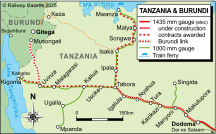
AFRICA: Construction of a railway from Uvinza in Tanzania to Musongati in Burundi was officially launched on August 16, with a ceremony at Rubara in Burundi’s Burunga province attended by the President of Burundi Évariste Ndayishimiye and the Prime Minister of Tanzania Kassim Majaliwa.
A US$2·15bn contract to build the 240 km electrified standard gauge line was signed in January by the two governments, China Railway Engineering Group and China Railway Engineering Design & Consulting Group. The work is expected to take six years.
Financing is being provided by the African Development Bank through a concessional loan.
Economic integration
The line is expected to strengthen economic integration and trade in the region by reducing significantly the cost of transporting goods and people between the two countries. It will serve three stations in landlocked Burundi and five in Tanzania.
Majaliwa said passengers from Burundi would be able to reach Dar es Salaam within a day, while freight transit times would be cut from 96 h to 20 h.
Freight traffic is expected to include minerals such as nickel, platinum, palladium, copper, gold and iron from Burundi for export through the Indian Ocean port, with flows of up to 3 million tonnes annually.
Tanzania’s Minister of Transport Makame Mbarawa said the cost of transporting a 20 ft container would be reduced from US$3 800 to US$2 000.
A happy day
President Ndayishimiye said the presence of high-level officials from the two countries at the launch ceremony reflected the importance of the project in strengthening ties of friendship, co-operation and solidarity.
‘Today is a very happy day for us’, he confirmed. ‘We’ve had a lot of conversations from time to time. In 1921, this project was started by the Belgians and then came the Germans but failed. Today in Tanzania and Burundi we have succeeded.’
Looking ahead, he said that ‘we want the railway to connect to Kindu, in the east of DR Congo. And after that, we want the rails to reach West Africa, on the shores of the Atlantic Ocean, as we believe the route will accelerate development.’
Peace Agreement between the Democratic Republic of Congo (DRC) and Rwanda: Is this for Real?
On By Dr. Y.
Map of the Democratic Republic of Congo
We have been told to applaud the recent “peace” agreement between the Democratic Republic of Congo (DRC) and Rwanda. It can be accessed on the US Department of State website both in English and French.
Last week, on
Flag of the Democratic Republic of Congo
June 27, 2025, the Foreign ministers of the DRC and Rwanda, Therese Kayikwamba Wagner and Olivier Nduhungirehe, respectively, in the presence of United States President Donald Trump in the Oval Office of the White House signed a peace agreement. Some of the key points of this peace agreement are : 1) Territorial integrity and prohibition of hostilities: both nations pledge to respect the territorial integrity of the other and its sovereignty – not sure why both, since the Rwanda of Paul Kagame has always been the aggressor and the one not respecting and violating the DRC territory and people. 2) Disengagement, disarmament, and integration of non-state armed groups
USA et Tanzanie remplacent le Rwanda: la fin de l’ère Kagame en Afrique de l’Est?
23 April 2025
Imaginez un instant que le Rwanda, longtemps allié clé des États-Unis en Afrique et modèle de stabilité, soit soudainement éclipsé. Accusé de soutenir le chaos dans l’est de la RDC via le groupe M23, le pays de Paul Kagame perd du terrain au profit de la Tanzanie. Ce revirement géopolitique, marqué par un renforcement de la coopération militaire USA-Tanzanie, redessine la sécurité en Afrique de l’Est. Pourquoi ce changement ? Quelles sont les implications pour la région des Grands Lacs ? Cette vidéo explore les raisons et les conséquences de ce tournant majeur.
La région des Grands Lacs, incluant la RDC, le Rwanda, le Burundi, l’Ouganda et la Tanzanie, est un foyer de tensions historiques et de conflits armés, alimentés par des ressources minérales et des rivalités. Depuis 1994, le Rwanda de Kagame, avec son développement économique et son armée puissante, était un partenaire stratégique des États-Unis. Mais les accusations de soutien au M23, un groupe armé actif en RDC, ont terni cette image. En 2024 et 2025, le conflit a déplacé plus de 400 000 personnes, et des rapports de l’ONU estiment que 3 000 à 4 000 soldats rwandais sont impliqués, exacerbant la crise humanitaire.
Les États-Unis, qui ont investi massivement au Rwanda (116 millions de dollars annuels dans la santé et une coopération militaire étroite), semblent perdre patience. En 2023, une partie de l’aide militaire rwandaise a été suspendue, et en avril 2025, un conseiller américain a exigé le retrait des troupes rwandaises de RDC. Cette fermeté marque un changement de cap, avec la Tanzanie émergent comme nouvel allié. Des exercices militaires conjoints, comme Justified Accord 2025 et Cutlass Express, prévus en février 2025, renforcent les capacités tanzaniennes en maintien de la paix et sécurité maritime.
La Tanzanie, perçue comme neutre et stable, est un choix stratégique. Ses forces armées, les TPDF, sont respectées, et sa position sur l’océan Indien en fait un atout contre le terrorisme et la piraterie. Contrairement au Rwanda, la Tanzanie n’est pas entachée par des accusations d’ingérence, ce qui en fait une alternative crédible pour les missions de l’ONU. Ces exercices militaires visent à préparer la Tanzanie à des opérations complexes, comme la lutte contre le M23 en RDC, où elle déploie déjà des troupes via la SADC.
Ce pivot géopolitique isole Kagame, dont le soutien occidental s’effrite. Ses voisins, comme le Burundi, s’alignent contre le M23, et la SADC adopte une posture défensive. Cependant, ce changement comporte des risques : une dépendance excessive envers la Tanzanie pourrait reproduire les erreurs du passé, et marginaliser le Rwanda pourrait pousser Kagame vers la Russie ou la Chine. De plus, la crise en RDC persiste en raison des faiblesses structurelles de l’État congolais, nécessitant des solutions au-delà d’un simple changement d’allié.
Ce virage offre une chance de repenser la sécurité régionale, en privilégiant la coopération et le respect de la souveraineté. Les États-Unis doivent soutenir des initiatives comme l’Accord-cadre d’Addis-Abeba et imposer des sanctions ciblées. La région des Grands Lacs est à un carrefour : continuer le cycle de violence ou bâtir un modèle de paix collaborative. Abonnez-vous pour explorer davantage la géopolitique africaine et partagez votre avis en commentaire !
SUPERB SUMMARY OF RECENT HISTORICALLY CRITICAL DOCUMENT published on this website on 31 Dec 2024 which is reaching a record breaking number of visitors world-wide
re posted from THE RWANDAN
The Banyarwandan Doctrine: A Supremacist Ideology Undermining Stability in the Great Lakes Region of Africa
12 January 2024
Dr. Jean-Marie Vianney Higiro’s extensive exploration of the Banyarwandan Doctrine unveils a complex and insidious ideology that has left an indelible mark on the Great Lakes region of Africa. Through his critical analysis, Dr. Higiro delves into the roots, manifestations, and far-reaching consequences of a hegemonic worldview that seeks to unify all Kinyarwanda-speaking people under a singular political and cultural umbrella. This ideology, he argues, serves as both a mechanism of expansionism and a driver of persistent conflict in the region.
From his personal experiences in the Ugandan province of Kigezi, where he grew up speaking Oruciga, a language distinct from Kinyarwanda, Dr. Higiro recalls an environment in which social identity was not determined by ethnicity but rather by shared cultural and linguistic bonds. In Rushaki, his village on the border of Uganda and Rwanda, peaceful coexistence among diverse groups stood in stark contrast to the rigid ethnic identities that later came to dominate Rwandan society. Over time, however, the label “Banyarwanda,” once emblematic of linguistic unity, has become a tool for political violence and hegemonic aspirations, promoted by the current Rwandan government in its quest to defend the rights of Kinyarwanda speakers across international borders.
The evolution of this ideology is deeply intertwined with the history of migration and displacement in the Great Lakes region. Kinyarwanda-speaking communities are dispersed across Uganda, Tanzania, and the Democratic Republic of Congo (DRC), where they arrived in waves over centuries. In the DRC, for instance, Banyarwanda populations such as the Banyamulenge and other groups of Tutsi origin were established as early as the 18th century, long before colonial boundaries were drawn at the Berlin Conference of 1884–1885. These communities, often marginalized and excluded from political representation, became fertile ground for the development of a collective identity centered around the defense of their rights. Similarly, in Uganda and Tanzania, Banyarwanda populations have grappled with exclusion and xenophobia, despite their long-standing presence in these territories.
The roots of the Banyarwandan hegemonic ideology can be traced to the struggles of Tutsi refugees who fled Rwanda after the 1959 Social Revolution. This pivotal event marked the overthrow of the Tutsi monarchy and the ascent of a Hutu-led government, resulting in the exile of many Tutsi aristocrats. Dispersed across neighboring countries and facing economic and social hardships, the exiled aristocracy sought to reclaim power in Rwanda through various means, including the establishment of transnational organizations and publications. The Association of Banyarwanda in Diaspora (USA), formed in the United States, became a prominent platform for articulating this ideology. Through its publication Impuruza, figures such as Alexandre Kimenyi and George Rubagumya propagated a vision of uniting all Kinyarwanda speakers, regardless of nationality, under a single political and cultural framework.
The ideological underpinnings of the Banyarwandan Doctrine found their most prominent champion in the Rwandan Patriotic Front (RPF), which launched an armed struggle to reclaim power in Rwanda. The RPF portrayed itself as a multiethnic force, uniting Tutsi refugees and Hutu disaffected by the Habyarimana regime. This narrative of inclusivity, however, masked a more insidious agenda rooted in the restoration of Tutsi aristocratic dominance. The RPF’s invasion of Rwanda in 1990 marked the beginning of a brutal conflict that culminated in the 1994 genocide, during which the regime successfully seized power. Since then, the RPF-led government has positioned itself as the defender of Kinyarwanda-speaking people, justifying military interventions and political meddling in neighboring countries under the guise of protecting these communities.
Dr. Higiro highlights the role of Western media and advocacy organizations in disseminating the Banyarwandan hegemonic ideology. Journalists such as Catharine Watson, writing for publications like Africa Report and The Guardian, often uncritically echoed the RPF’s narrative, framing Tutsi refugees as perpetual victims of oppression in the Great Lakes region. This portrayal reinforced stereotypes rooted in the colonial-era Hamitic hypothesis, which depicted Tutsi as a superior race of Nilotic origin. By conflating Banyarwanda with Tutsi and portraying the RPF as a multiethnic liberation movement, such coverage obscured the complex realities of the region and lent legitimacy to the RPF’s militaristic agenda.
The consequences of the Banyarwandan Doctrine have been devastating for the region. In the DRC, where Rwanda has actively supported armed groups such as the M23 and the National Congress for the Defense of the People (CNDP), the doctrine has fueled cycles of violence that have claimed millions of lives. Under the pretext of defending the rights of Congolese Tutsi, Rwanda has pursued a policy of destabilization, exploiting ethnic tensions and fostering proxy wars. This expansionist agenda, Dr. Higiro argues, is rooted not in genuine concern for Kinyarwanda-speaking communities but in a desire to maintain political and economic dominance in the region.
President Paul Kagame, the RPF’s leader, embodies the contradictions and hypocrisies of the Banyarwandan hegemonic ideology. While presenting himself as a revolutionary committed to social justice, Kagame has presided over a regime characterized by authoritarianism, ethnic polarization, and extrajudicial violence. His government’s dehumanization of Hutu populations and its propagation of a Tutsi-centric narrative of victimhood have deepened divisions within Rwanda and undermined prospects for reconciliation. Moreover, Kagame’s rhetoric of defending the rights of Kinyarwanda speakers in the DRC rings hollow in light of his regime’s complicity in human rights abuses and its support for rebel groups that have inflicted untold suffering on Congolese civilians.
The Banyarwandan Doctrine represents a dangerous form of identity politics that conflates language, ethnicity, and political allegiance. By invoking the rights of Kinyarwanda speakers as a pretext for military interventions and territorial ambitions, the Rwandan government has perpetuated instability across the Great Lakes region. This ideology mirrors the expansionist aspirations of pan-Germanism in Europe, which sought to unify German-speaking populations under a single state. Just as pan-Germanism sowed the seeds of conflict in Europe, the Banyarwandan Doctrine threatens to destabilize the Great Lakes region for generations to come.
Dr. Higiro’s analysis underscores the urgent need for the international community to confront the implications of the Banyarwandan hegemonic ideology. By exposing its expansionist and supremacist underpinnings, his work challenges the narrative of victimhood that has shielded the Rwandan government from scrutiny. To achieve lasting peace and stability in the Great Lakes region, it is imperative to reject ideologies that prioritize ethnic solidarity over inclusive governance and to hold accountable those who exploit such ideologies for political and economic gain.
In conclusion, according to Dr. Higiro, the Banyarwandan Doctrine is more than a mere expression of cultural pride or linguistic unity; it is a supremacist and hegemonic ideology that has wrought havoc on the Great Lakes region of Africa. Rooted in the historical grievances of exiled Tutsi aristocrats and perpetuated by the Rwandan Patriotic Front, this ideology has justified decades of violence, displacement, and instability. By conflating the identities of Kinyarwanda speakers with the political ambitions of a ruling elite, it has undermined the social fabric of the region and perpetuated cycles of conflict. Dr. Jean-Marie Vianney Higiro’s critique serves as a powerful call to action, urging policymakers, scholars, and activists to dismantle the structures of oppression and exclusion that sustain the Banyarwandan Doctrine and to build a future founded on justice, equality, and mutual respect.
Mozambique: Common Interests in Conserving Lawlessness
and `Terrorists` Herd Goats
by PD Lawton 9 January 2025
this article is Part 7 of a series documenting the rise of Paul Kagame and the destabilization of the Great Lakes. Part 1 is titled `Sun City` which can be found by typing into the search bar
Mozambique`s liberation party, FRELIMO, won the elections last year in October in an apparent landslide win. The party has been in power since 1975. Daniel Chapo will replace President Filipe Nyusi who has served two terms. However, current events are volatile and at the time of writing it appears Venâncio Mondlane from the opposition, RENAMO, will take government.
FRELIMO was declared the winner in 64 out of 65 municipalities and has denied fraud. Post-election protests erupted across the capital, Maputo, and across the country as far up as Nampula Province in the north with numbers of protestors having been killed by state law enforcement. The main opposition party , RENAMO under Venâncio Mondlane, is continuing to call for public demonstrations and is contesting the election results at the Constitutional Court
Image: Maputo anti FRELIMO demonstrators hold placard which reads:`I didn’t vote for the people in power`
Civil unrest, mass demonstrations and the demographics of the young unemployed are not the incumbent government`s only problem as northern Mozambique , completely underdeveloped and with porous borders, becomes the next African region to become ungovernable due to militia terrorism, amid the natural gas and rubies. But is the terrorism in the north a problem for the government or is it not a problem? Do members of the ruling party have common interests in conserving instability and lawlessness in Cabo Delgado Province? And just how strong are these ties of common interest between members within FRELIMO and members within South Africa`s government? Will a change in Mozambican government be any change at all?
Image: Wikipedia : Opposition leader Venâncio Mondlane
It would appear Mondlane has been groomed for his position, riding on the Brand of Mozambican hero Eduardo Mondlane to whom he is related ,and will implement liberal economic reforms on behalf of his foreign corporate groomers who have shares in the LNG project.
Wikipedia is an online information aid that pretends to be unbiased and privately operated, however, it provides `the official narrative`, the victor`s version of events. Like Google it is a Western intelligence -run operation to drive propaganda. A Google/Wikipedia search of Mozambique terrorism provides the following:
“The insurgency in Cabo Delgado is an ongoing Islamist insurgency in Cabo Delgado Province, Mozambique, mainly fought between militant Islamists and jihadists attempting to establish an Islamic state in the region, and Mozambican security forces. Civilians have been the main targets of terrorist attacks by Islamist militants. The main insurgent faction is Ansar al-Sunna, a native extremist faction with tenuous international connections. From mid-2018, the Islamic State’s Central Africa Province has allegedly become active in northern Mozambique as well, and claimed its first attack against Mozambican security forces in June 2019. In addition, bandits have exploited the rebellion to carry out raids. As of 2020, the insurgency intensified, as in the first half of 2020 there were nearly as many attacks carried out as in the whole of 2019. Ansar al-Sunna (English: “Supporters of the Tradition”) is similar to the name of an Iraqi Sunni insurgent group that fought against U.S. troops between 2003 and 2007. They are known locally as al-Shabaab but they are not formally related to the better known Somali al-Shabaab. Some of the militants are known to speak Portuguese, the official language of Mozambique, however others speak Kimwane, the local language, and Swahili, the lingua franca language spoken north of that area in the Great Lakes region. Reports also state that members are allegedly mostly Mozambicans from Mocimboa da Praia, Palma, and Macomia districts, but also include foreign nationals from Tanzania and Somalia. ”
The information above is not a clarification of reality. It is a badly hatched intelligence plot which could have been written by a CIA/MI6 under-graduate with a high UN security clearance. It does not reflect reality. It reflects a wannabee plot to justify the raison d`etre of the War on Terror and the latest funneling of liquid cash down the throat of the Western Warlords most distinguished conduit, Paul Kagame, president of Rwanda. It is the script for the next Hollywood film about saving Africa from Africans and the next location for the Anglo American controlled United Nations foreign occupation.
If violence in northern Mozambique spirals out of control, as it is, a UN Peacekeeping operation will be allocated to occupy Mozambique territory. As with MONUSCO , the UN Peacekeeping force in eastern DRC, and the majority of UN Peacekeeping operations elsewhere across the continent, it will remain in place for decades to safeguard this well-known narco route, human trafficking route and region rich in natural gas ,oil , rubies and other resources. Terrorism will continue to create lawlessness and continue to turn the people who live in the region into the next batch of IDPs (Internally Displaced People), refugee pawns for the `human rights` war game on Africa.
[ see article : `UNHCR`s Concentration Camps in Goma : the refugee pawns for Kagame`s war on Congo `by this writer]
Back in Time
Under colonial Portuguese rule Maputo or Lourenço Marques as it was called then, as the capital of Mozambique was a tourist destination for white South Africans and the playground of the Portuguese middle class with jazz bands and later in the 1980s Tom Jones performing at the famous Costa do Sol on the Avenue Marginal. Life was `good for the blessed and short and sharp for the rest`.
Portuguese colonial rule of Angola and Mozambique was long lived and particularly nasty under the government of António de Oliveira Salazar which was finally overthrown in Portugal by the Carnation Revolution in 1974.
Ghana`s formidable Pan African statesman, Kwame Nkrumah, made a curiously interesting point about Portugal during a famous speech given by him on neo-colonialism. He said :
“The imperialist powers that have brought in their vassals, Spain and Portugal, Portugal in fact since the wars of Spanish succession 1700 -1714, being a protectorate of Britain, which has enjoyed special trading and unnecessary rights in both Portugal and the Portuguese territories for over 200 years.”
video: uploaded by CPPGhanaOnline: NKRUMAH SPEECH FORCES AGAINST AFRICA
In a mirrored reflection of the Angolan struggle against colonial rule, Mozambicans were to achieve self-government only to find they would face an extended battle in a foreign instigated and funded civil war, a war which would result in near total destruction of the country`s infrastructure, economy and social cohesion thereby justifying the words of those who would say Africans are incapable of governing successful economies. In Angola, a civil war lasted from the mid 1970s up until the early 2000s. The war claimed millions of lives, Angolan, South African and Cuban.
A private military company, Executive Outcomes, was hired by President Aghostino Neto`s government in the early 1990s to end the UNITA insurgency. Executive Outcomes successfully achieved their mandate however foreign forces, particularly those residing in South Africa, went to inordinately great lengths to re-ignite the war and discredit the reputation of Executive Outcomes. The objective of these foreign forces was to perpetuate destabilization and civil war for as long as possible while reaping the harvest of diamonds for Harry Oppenheimer`s DeBeers.
Resistance to Portuguese colonial rule formed into FRELIMO, Frente de Libertação de Moçambique, under the leadership of Eduardo Mondlane.
Image: Wikipedia: Eduardo Mondlane
FRELIMO was supported by the socialist Non-Aligned Movement and PanAfricanist leaders of the era such as Kwame Nkrumah of Ghana, Nasser of Egypt, Modibo Keita of Mali and Sekou Toure of Guinea , Patrice Lumumba of Congo, who represented the fordible calibre of leadership of those times.
FRELIMO gained power in 1975 with Samora Machel as the first president. Eduardo Mondlane had been assassinated in 1969 by an explosive device concealed in a parcel delivered to him while in Tanzania. [1]. Samora Machel was assassinated in a plane crash in 1986, brought down by a South African intelligence operation.
By 1976 civil war had erupted in Mozambique with the formation of RENAMO. This civil war, as with that which unfolded in Angola to counter the implementation of peace and prosperity of the elected govenment of Aghostino Neto under the MPLA [2], turned into a protacted and extremely brutal period which only ended in 1992 with the transition in South Africa from Apartheid to democratic rule.
RENAMO, Resistência Nacional Moçambicana, formed in northern Mozambique as a regional tribal interest in securing power in a FRELIMO dominated government, obstensively opposed to their communist ideology. Taken in the context of other African liberation stories it is most likely the case that Ian Smith`s Rhodesia took foreign funding to help form RENAMO as part of the Cold War playbook, pitting opposing forces of Western democracy and Russian communism against each other, both ulitimately stemming from the same source as the City of London bankers financed the Bolshevics and Karl Marx. Tiny Rowland of Lonhro would have played a similar role as his role in Angola.[3] Rhodesia ( now Zimbabwe) was also backing RENAMO as the FRELIMO government were harbouring and supporting Robert Mugabe`s ZANLA , Zimbabwe African National Liberation Army. Apparently Samora Machel disliked Mugabe and called him out as a CIA asset.
In the South Africa of the 1980s with the South African Border Wars in full swing in Angola and South West Africa ( now Namibia), it was common knowledge that South Africa was running RENAMO. [2]
In 1992 the Rome General Peace Accords were signed between FRELIMO and RENAMO.The Catholic Church of Rome were responsible for brokering the peace negotiations. Northern Mozambique continued to remain underdeveloped by the Maputo orientated FRELIMO government.
And all became quiet in northern Mozambique for awhile.
Fast Forward to Natural Gas
In 2009 oil prospectors from a Texan company , Anadarko, declared the discovery of one of the world`s biggest reserves of LNG natural gas off the coast of Cabo Delgado, northern Mozambique.
Anadarko , having spent billions on prosecting, procuring and construction of facicilities sold its stake in the venture to Total Energy according to this Reuters article dated 2019:
Anadarko has agreed to be taken over by Occidental Petroleum Corp. Anadarko led a liquefied natural gas project in Mozambique, but was replaced by Total after the French oil major agreed to buy Anadarko’s African assets for $8.8 billion as part of the Occidental takeover. Total will be the main operator of Mozambique LNG with a stake of 26.5%. ENH Rovuma Área Um, S.A. will own 15%, Mitsui E&P Mozambique Area1 Ltd will hold 20%, ONGC Videsh Ltd, Beas Rovuma Energy Mozambique Limited and BPRL Ventures Mozambique each have 10%, while PTTEP Mozambique Area 1 Limited will have 8.5%.
In 2013 RENAMO discarded the peace agreement blaming a Mozambican military attack on their headquarters. Out of the blue RENAMO re-immerged in shiny new uniforms with shiny new weapons.Who supplied the new equipment for the re-invention of a militarized RENAMO?
In 2020 Al Jazeera conducted an extensive interview with the founder of Executive Outcomes, Major General Eeben Barlow who can undoubtably be considered the African who knows more than any other about the foreign backed insurgencies that have, and continue to plaque the continent. He has been described as the nemesis of the Warlords of Westminster and Washington:
Major General Eeben Barlow
Interviewer: “ But what happened to that progressing and once progressing and relaxed country like Mozambique , I mean it was stable and progressing and peaceful. Why such an influx of pmcs ( private military companies)?
Eeben Barlow: “ Ironically they dicovered oil and gas. It doesn`t take rocket science to figure out that any country that discovers oil and gas is suddenly going to find themselves under severe threat from many quarters as people try to claim that oil and gas for themselves. We see Mozambique shortly after the oil and gas discovery was announced , a previous liberation movement known as RENAMO suddenly reappeared with new equipment and new uniforms. Where did they get that from? “
Interviewer: “ Where do you think they are getting that from?”
Eeben Barlow: “ Well, we can only speculate on that, so I don`t have the proof of that butit doesn`t take rocket science to figure out who was up there when the oil and gas was discovered .”
video: Al Jazeera : Eeben Barlow: Inside the world of private military contractors – Part 2 | Talk to Al Jazeera
ISIS in Africa : Recycling Africa`s Mercenaries
In 2020 Tanzanian authorities apprehended 600 mercenaries en route to the DRC. They were Eritreans, Somalians and Ethiopians, seasoned fighters, spill-overs from Al-Shebaab, Boko Haram and the TPLF.
The fundamental that one must remember is that the ADF ( Allied Democratic Forces) that are operating in North Kivu and Ituri provinces of the eastern Democratic Republic of Congo are solely comprised of foreigners who are Islamic extremists and who conduct acts of terrorism on the local Congolese populations that are so extremely barbaric in nature that they defy words. The acts include amputations, mutilations and cannabilsm. South Africa is fully aware that ADF members routinely cross its borders and in effect operate from with the Republic of South Africa.Evidence of this is in the multiplication of miliary training camps in remote parts of the country with their existance coverered up by the State.
Video: BizNews TV :Acquitted SAPS whistleblower reveals secret military training camp cover-up…
In Mozambique in 2017 an insurgency of Islamic militants emerged in Cabo Delgado Province calling themselves Ansar al-Sunna. Their purpose is to terrorize the local population whereas their scorched earth policy does not apply to resource extraction. Ansar al-Sunna have never attacked the LNG project. Since 2017 over 1 million Mozambicans have become IDPs, Internally Displaced People. Over 4000 people have been murdered, many by the most grotesque acts of be-heading and cannibalism. In 2020 , three videos were circulated on social media. The first was of a woman, stripped naked, walking in front of a group of soldiers, they are interrogating her as she walks, naked. She turns to them and they shoot her point blank in the head, naked. The second showed an attack on a bus moments after it occurred. A young man lurches towards the person filming, vomiting blood before he collapses. The female passengers on the bus lie dead and dying with their clothes torn, their underwear showing, the foot well of the bus driver`s seat is a pool of blood. The third shows a man speaking in Portuguese to the person filming. He is surrounded by mutilated and beheaded bodies. He bends down and hacks off the arm of one of the men lying at his feet . [edit: the third video is more like ADF [ Allied Democratic Forces} in DRC]
In late 2020 when violence spiked, 50 local people were taken to a football ground and be-headed.
“Observers say the evolution of the insurgency in Mozambique is remarkably similar to Boko Haram’s emergence in northern Nigeria, with a marginalised group exploiting local grievances, terrorising many communities, but also offering an alternative path for unemployed youths frustrated by a corrupt, neglectful and heavy-handed state.”
The FRELIMO government has attempted to downplay the terrorism occurring in the completely under developed and neglected north. However the former president Nyusi made a recent speech in which :
“Mozambican president Filipe Nyusi warned on Friday that terrorism could divide the country, advocating that everyone unite to fight rebel groups in Cabo Delgado province, in northern Mozambique.”
One wonders if Nyusi has become concerned that the monstrosities his government has allowed to take place is now becoming a threat to FRELIMO power. Recent post election events are proving this to be the case. However, the FRELIMO government has fulfilled its duty and turned the insurgency into a regional problem. Since July 2021 South African Development Community forces and the Rwandan Defense Force have been operational in the area.
Come Join the Party. Giving Kagame Something to Fight
“Mozambican President, Filipe Nyusi, on Monday called again for arms support from the European Union (EU) to combat terrorism in Cabo Delgado.
“That support for Mozambique is not limited only to non-lethal [equipment],” given the need to make “the defence and security forces more robust for combat intervention,” Nyusi urged on the sidelines of the opening of the ACP-EU Joint Parliamentary Assembly, meeting in the Mozambican capital, set to run for the next three days.
The head of state also asked that financial support already allocated by the EU for military support for the Southern African Development Community (SADC) ) should also be granted to Rwanda, which also supports Mozambican troops in Cabo Delgado – particularly in areas to which the country wants the return of natural gas projects.
The EU announced in early September the allocation of €15 million for the SADC Mission in Mozambique (SAMIM), notably for field fortifications and storage containers, medical equipment, vehicles and boats, as well as technological devices.
This instalment complements an €89 million funding to Mozambique’s armed forces aimed at equipping the units being trained by the EU mission in the country.
Terrorism is one of the issues on the agenda of the African, Caribbean and Pacific (ACP) assembly and the EU, and MEP Carlos Zorrinho, co-chairman of the assembly, had already announced in his speech that the EU would take further steps to support Mozambique in Cabo Delgado, without giving details.
He said that the delivery of lethal weapons “is not normally” in the EU’s support package, “but there are many ways of helping and cooperating, without necessarily having to supply weapons”.
Mozambiquans deeply resent the presence of Rwandan forces in their country. A video on Tik Tok shows local people in their numbers blocking a road in Bobole, Maputo Province, to stop the Rwandan military vehicles from entering the town. People are shouting “Get out Rwanda! Go back home to Rwanda! ”
Video: uploaded by Africa Flashes: Mozambicains, lassés des Rwandais déstabilisant leur pays, expulsent les soldats du RDF!
Home Grown or Implanted ?
A video conference held in 2021 by the Centre for Strategic and International Studies is an example of UN policy which is to deliberate a crisis for long enough to allow the situation to escalate and the region to become ungovernable.
“For Hanna Tetteh, the priority should be to “be able to understand what the challenges within the Cabo Delgado region are and how we are going to support the Southern African Development Community (SADC), which has demonstrated that it wishes to take leadership of this issue. The support has to be given by bringing “the political tools to bear to try and create solutions within those regions and deal with some of the governance deficits that they have – lack of service provision, challenges with inequality – and, of course, at the same time, to provide a humanitarian response.” She emphasized.”
At the time of this CSIS meeting the Nyusi government had already received a proposal to resolve the insurgency in Cabo Delgado by an organization with a track record of success, an organization that is more accomplished than any foreign private military company such as Wagner at resolving insurgencies on the continent because it is an African private military company, Executive Outcomes. In its own words :
“Executive Outcomes is an apolitical South African-based and African-staffed company that gained international recognition for assisting and advising Africa governments―over a period in excess of 40 years―to decisively and effectively combat armed threats to their sovereignty.”
The proposal is in a document titled:
PRE-PROPOSAL DISCUSSION DOCUMENT : AN APPROACH TO DEFEATING THE ISLAMIST INSURGENCY IN NORTHERN MOZAMBIQUE, 3 November 2020.
It was handed to The Defence Attaché, Colonel Simon Zengeri in Pretoria, South Africa.
Not only was the Nyusi government in receipt of this workable proposal but the proposal came already financed by a philanthropic organization.
And yet the Nyusi government did not accept the proposal and acted instead in accordance with its co-criminal allies and hired a Russian private military company and a SADC force that were set up to fail resulting in the use of the Rwandan Defense Force for which Paul Kagame`s Rwanda has been awarded millions by the European Union for its defense budget.
As things stand today the foreign backed insurgency in Cabo Delgado Province has indeed resulted in the destabilization of northern Mozambique, the downfall of the FRELIMO government , the obstruction of the development of the new gas and oil industry for the benefit of the State, destroyed a good and developing tourism sector , driven off foreign investment and cost the lives of thousands and suffering of a million and more people.
The media, and FRELIMO government, intentionally push the point that the Islamic insurgency in the north is a result of poverty and under development, that it is `home grown`. Such a narrative normalizes the existence of cannibalistic terrorists, as if somehow local Mozambicans could become so radicalized that they could turn upon each other and perform acts too grotesque for words. The insistence that radical Islam is being normalized, routinized is a cover story , a very dangerous cover story that has only one purpose and that is acceptance. It is desired of the general public that they believe the terrorists are the good guys and that leadership that happens to be Muslim in faith, are the bad guys.
video: uploaded by the Schiller Institute: Syrian Ambassador to UN Address to Schiller Institute September 11 Memorial Conference,Date: 2016: Permanent Representative to the United Nations from the Syrian Republic, Bashar Jaafari as Syria undergoes destabilization
Radical Islam is never home grown. Radical Islam is venture capitalism. It runs on oil or drugs or human trafficking. That is how it funds itself. In 2010 British academic, Mark Curtis, published ` Secret Affairs: Britain`s Collusion with Radical Islam.`
The book illustrates how radical Islam has been nurtured. British investigative journalist, Vanessa Beeley, has documented the creation of the Free Syrian opposition in Syria by Britain. Her work can be viewed Here on her Substack. Note how Wikipedia is used to malign her work. Her work and archives of it dating back to the start of Syria`s destabilization, can be found on the UK Column.
Image: courageous British journalist Vanessa Beeley
That radical Islam is synthetic , is an open secret. It is the secret army of the Warlords of Westminster and Washington as explained to those who will listen by the extraordinary brave Americans, former CIA Intelligence analysts such as Larry Johnson, Scott Ritter and others of their ilke.
Video: Uploaded by Dialogue Works : SYRIA IN TURMOIL: Shocking Escalation You Won’t Believe! | Larry C. Johnson & Scott Ritter
The following is a quote from a recently published book. The author`s words from 2016 were prophetic. All that he warned has now come to pass.
“On 27 May 2016, a meeting with a representative of the Mozambiquan government resulted in me writing a confirmatory letter to him – on his request. In it, I stated:
Our discussion on 27 may 2016 re Mozambique refers:
I believe one must first analyze and consider the comment made by Zbigniew Brzezinski- President Obama`s foreign policy advisor on Africa – that a divided and warring Africa serves the very best interests of the US. Brzezinski stated: “…protecting access to hydrocarbons and other strategic resources which Africa has in abundance, (is) a task which includes ensuring against the vulnerability of those natural riches and ensuring that no other interested third parties , such as China, India, Japan, or Russia, obtain monopolies or preferential treatment. “
My letter went on to state:
In the coming months, the government of Mozambique can expect attacks across all of its Pillars of State with the aim of destabilizing and discrediting both the government and the security forces ie Intelligence, Police and the Armed Forces…….Pressure will also be put on the IMF and World Bank to deny Mozambique access to foreign capital and loans. Regardless, these actions will erode the economy…”
Footnotes:
[1] Tanzania has a curious role in the liberation era. PanAfricanists abhore the notion that Julius Nyerere was anything other than a liberation saint. Tanzania acted as a breeding ground for lfeftist marxist ideologogy and schooled many of Africa`s leadership in marxist rhetoric. Unbeknown to many of the time, their marxist rhetoric would serve as justification for the Cold War to play out across Africa.
[2] John Stockwell was the CIA field operator in Angola under orders from Henry Kissinger to make life as difficult as possible for the liberation government of Aghostino Neto. He documented his mission in his whistelblower book `In Search of Enemies`. The CIA crafted Holden Roberto`s FNLA while the Anglo American network of Harry Oppenheimer worked with Angus Oglivy and Tiny Rowland in support of Jonas Savimibi`s UNITA party who paid in diamonds. South Africa was then brought in to use its soldiers to fight with RENAMO and UNITA, allies in the Cold War in Africa.
The EAC’s ambitious vision for embarking on this integrated mega railway project gained momentum. This was catalyzed by Tanzania just recently launching SGR services linking Dar es Salaam to Dodoma. Also, Uganda embarked on plans of setting up its SGR links to the surrounding countries. The countries include Kenya, Rwanda, Democratic Republic of Congo, and even South Sudan.
East Africa’s 6,220-Kilometers Standard Gauge Railway (SGR) Project: Promoting Economic Integration within the Region
This ambitious railway project will pass through all the EAC member states and promote economic integration within the region
The East African Community (EAC) member states have revealed ambitious plans that will foresee the development of railway infrastructure. The plans entail developing an expansive East Africa’s 6,220-Kilometer Standard Gauge Railway (SGR) Project. This railway network is expected to link all the eight member states upon completion.